Pour toujours et toujours
Opening June 13 2025 | 6PM
Solo show | June 13-28 2025 at Glassbox-Sud
13 Rue de Belfort, 34000 Montpellier
It’s generally through a series of small steps that Myriam Jacob-Allard envisions the mechanics of a story. Bit by bit, people, things and gestures take shape to form the outlines of counternarratives reflecting that which was said and that which remains to be seen, sketching out funny and sad family stories through fragments that are copied, isolated, repeated or superimposed — basically cut-and-paste.
But about those outlines: the blue and black that lengthen and confine the smaller bits, sometimes arranged onto a fictional grid, sometimes organized into scenarios. These scenarios can be seen as directions to follow “in the case of a film”, like the footnotes punctuating The North China Lover by Margueritte Duras, who decided to re-write her novel after seeing the film adaptation by Jean-Jacques Annaud, which she saw as overly estheticizing and entirely unlike what she had experienced and felt. For Marguerite and Myriam, the remake of a remake is just as much the symptom of an obsessive perfectionism as is it is an admission of failure: the impossibility of recounting what happened fully and truly, and the constant need to dive back into words. It must also be said that Duras ¾ and perhaps Jacob-Allard as well ¾ is a liar: she dreams her plots up, often re-writing events and contradicting herself, but that is what makes her writing so interesting.
The ”in the case of a film” notes of Myriam Jacob-Allard are reconstructions of excerpts gathered from vampire movies and embodied by the women who make up the artist’s family. Mother, sister, niece — each protagonist chosen from this imposed community is a threat to the narrative and sym-bolic structure: the nuclear, patriarchal western family with its obsession with legacy, its deadly desire for eternity. In Myriam’s films, there are no fathers — no men at all. No pred-ators or prey. Immortality becomes a question of transmission, not contamination, a collective project on a black background.
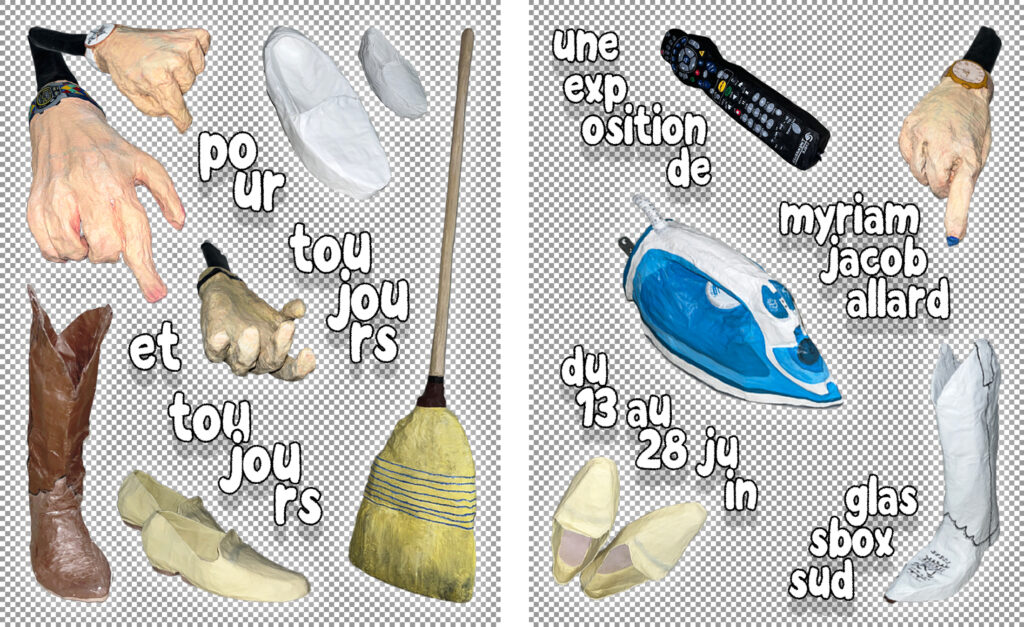
And then there’s the blue: a vain attempt to organize the drip lines of the collected memories of a middle-class family from Abitibi-Témiscamingue. A band-aid job with plenty of facsimiles, an inventory of tchotchkes (some absurd, some gloomy), an exercise in fill-in-the-blanks. These acts of mimicking, of cutting out and recomposing are inevitably awkward, but they reflect the awareness that it’s impossible to bring back what is gone, as well as the conviction that it’s still worth trying.
Annie Ernaux has said that the important thing in her writing is to “descend into the depths of reality, to achieve that realness that that is so hard to achieve, to go back in time, back to black.” Beyond the scopic drive triggered by Myriam’s domestic display of animated sculptures, her physical representations are also based in a movement, a back-and-forth between what has been and what remains.
Pour toujours et toujours doesn’t mean much in the language I share with Myriam. It’s a clumsy translation, or perhaps a dilemma: to live or let die. — Ugo Ballara [Translated from the French by Ellen Warkentin]